
Montana Property Taxes
Why did your Montana property tax bill change in 2026?
New rates, homestead enrollment, and local levies mean neighbors across the Bitterroot Valley are seeing very different bills. Whether you own, are buying, or are getting ready to sell, a quick review can tell you where you stand.
Book a Free ConsultationWhy Your Montana Property Tax Bill Changed in 2026
If you’ve opened your property tax statement and wondered why your bill barely moved while your neighbor’s jumped, you’re hearing a conversation happening across the Bitterroot Valley. Part of the answer goes back to 2023, and part comes down to how Montana taxes different properties in 2026.
How we got here
Montana’s 2023 reappraisal captured the sharp rise in home values during and after the pandemic. As residential values rose faster than some other types of property, homeowners picked up a larger share of the tax burden. A Montana Free Press analysis found that the median residential tax bill rose 21% statewide that year. In 2025, the Legislature passed House Bill 231 and Senate Bill 542, phasing in new rates over two years.
What it looks like in the Bitterroot Valley
Ravalli County saw a big jump in the latest reappraisal. The median assessed residential market value rose from $375,000 in tax year 2024 to $453,000 in 2025, an increase of 21%, close to the statewide increase of 22%. That $378,000 starting tier in the homestead rate isn’t random: it matches the statewide median residential value. Because many Bitterroot homes are now valued above it, part of a typical local home’s value falls into the higher 0.90% tier. Keep in mind this is a change in assessed value, not in tax bills. Each property’s bill also depends on its tax rate, local mill levies and any special assessments.
Why bills can look so different this year
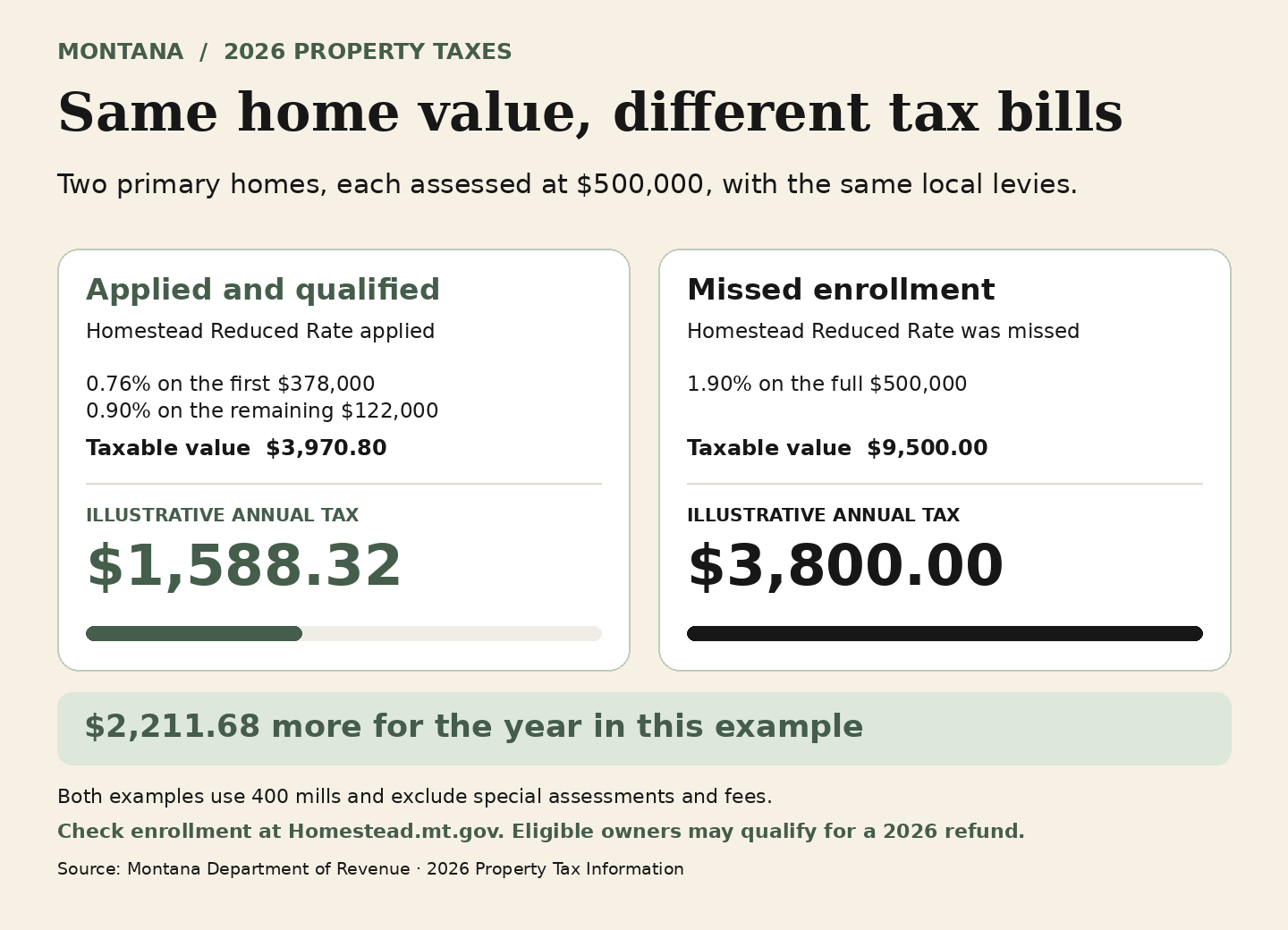
In 2025, Montana’s tiered rates applied broadly to residential property. In 2026, qualifying primary homes and long-term rentals receive reduced rates, while second homes and short-term rentals generally use a flat 1.90% rate to calculate taxable value. That higher rate can also apply to a primary home that missed enrollment. So even two homes with similar assessed values can end up with very different bills. Local mill levies and special assessments also affect the final amount.
Second homes, short-term rentals and long-term rentals
Montana’s 2026 property tax change treats second homes and short-term rentals differently from qualifying long-term rentals. In 2025, the same tiered rates generally applied to all three. Starting in 2026, how the property is used and whether it’s enrolled for the reduced rate can make a big difference.
| How the property is used | How Montana generally calculates its 2026 taxable value |
|---|---|
| Second home or vacation home | Flat 1.90% on the full assessed market value |
| Short-term rental, such as an Airbnb or VRBO | Generally the same flat 1.90% |
| Qualifying, enrolled single-family long-term rental | Same tiered rates as a qualifying primary home, starting at 0.76% on the first $378,000 and 0.90% on the next portion up to $756,000 |
| Qualifying multifamily long-term rental | Generally a flat 1.10% on the rental portion |
These percentages determine taxable value. Local mill levies are then applied to calculate the general property tax bill.
Why a vacation home’s bill can more than double
Using the same $500,000 home and 400 mills from the graphic above, the 2025 tiered rates would produce a bill of $1,656. In 2026, the same home used as a second home or short-term rental would come to $3,800, an increase of about 129%. As a qualifying, enrolled single-family long-term rental, it would come to $1,588.32. The example holds assessed value and mill levies steady and excludes special assessments and fees.
For the long-term rental rate, Montana generally requires tenants to use the property as their residence, with rental periods of at least 28 days at a time totaling at least seven months of the year. The owner must be current on property taxes and enroll the property. A rental owned through an LLC can qualify. Owners can check enrollment and apply for the 2027 rate through March 1, 2027 at Homestead.mt.gov.
What to check if your bill jumped
Start by comparing the full-year totals on your 2025 and 2026 statements. Then use the geocode on your bill to check whether the state applied the Homestead Reduced Rate. If you qualified but missed the rate in 2026, you may be eligible to request a refund January 1 through May 31, 2027, once your 2026 and prior-year property taxes are paid in full.
Key dates and who needs to enroll
- Now through March 1, 2027 — enroll for 2027: for qualifying primary homes and long-term rentals. This is how you lock in the reduced rate going forward. Apply online or by mail.
- January 1 – May 31, 2027 — request a 2026 refund: only for eligible primary homeowners who qualified for the homestead rate but didn’t receive it in 2026. Long-term rentals aren’t eligible for this refund.
If you received a Montana property tax rebate in 2025 and still own and live in the same home, you’re generally already enrolled and don’t need to do anything. You do need to enroll if you bought or built a home, moved, sold or transferred the property, had an ownership change, or didn’t receive a 2025 rebate.
The 2026 refund covers only the difference between the regular residential rate and the homestead rate, for one year. It’s for owner-occupied primary homes only. Rentals, second homes, vacant land, and homes owned by an LLC, corporation, partnership or irrevocable trust don’t qualify. You’ll need your Social Security number and your property’s geocode, and your 2026 and prior-year taxes must be paid in full.
Buying or selling a home?
Buyers: if the home you buy already has the Homestead Reduced Rate, it stays in place for the rest of that year, but you must enroll as the new owner to keep it for the next year. If the home wasn’t enrolled, it may be taxed at the 1.90% flat rate for that year, and you may be able to claim the difference as a refund later.
Sellers: the reduced rate is tied to the owner who lives there, so buyers will ask about it. Knowing the home’s enrollment status helps you answer questions about what taxes will look like after closing.
Questions about your situation? The Montana Department of Revenue’s call center is at 406-444-6900, or you can visit a local field office.
Helpful Resources
Official Montana tools for looking up your property and checking your homestead status.
Montana Cadastral
Look up your property, ownership details, and geocode on the state's property map.
Search property →Homestead Reduced Rate
Montana Department of Revenue information on the Homestead Reduced Rate and how to apply.
Visit Dept. of Revenue →2026 Property Tax Refund
Requirements for requesting a refund if you qualified but missed the reduced rate.
See refund details →Montana Property Tax Hub
The Department of Revenue’s central page for rates, deadlines, FAQs and county value changes.
Visit the hub →Property Tax Explained
A short video on how market value, tax rates and mill levies combine into your bill.
Watch the video →Let's take a look at your property taxes
Pick a time that works for you. We'll go over your assessment and what it means for your home, purchase, or sale.
Book Your ConsultationCourtney Ferguson · courtney-ferguson.com
This information is for general educational purposes and is not legal or tax advice. For official assessment and appeal information, contact the Montana Department of Revenue or your county.
 Broker License ID: RRE-BRO-LIC-108835
Courtney Ferguson is a Montana Real Estate Broker and REALTOR® with The Real Brokerage, based in Stevensville. She is a licensed broker and helps buyers and sellers across The Bitterroot Valley, including Lolo, Florence, Stevensville, Victor, Corvallis, Hamilton, Darby, Conner, and Sula. Same-day consultations are available, including weekends and holidays.
+1(406) 830-5474 home@courtney-ferguson.com2685 Eastside Hwy, Stevensville, MT 59870-6954, USA
http://courtney-ferguson.com