Montana Reservation Land
Buying land on a Montana reservation: what to verify before you make an offer
Land within reservation boundaries can have different ownership and transfer rules. Start with the legal description and what the seller can transfer, then confirm access, water, septic, and building approvals for the specific parcel.
Book a Free ConsultationBuying Land on a Reservation in Montana: What You Should Know
You’ve found a piece of land you’d like to build on. It has a road, room for a home, and a listing that mentions a well or irrigation. If the property lies within a Montana reservation, start by getting the legal description and finding out what the seller can transfer. Then confirm legal access, water, septic, and building approvals for the specific parcel.
Before you make an offer, ask for the legal description, any available title or lease documents, and copies of existing permits.
Montana’s seven reservations
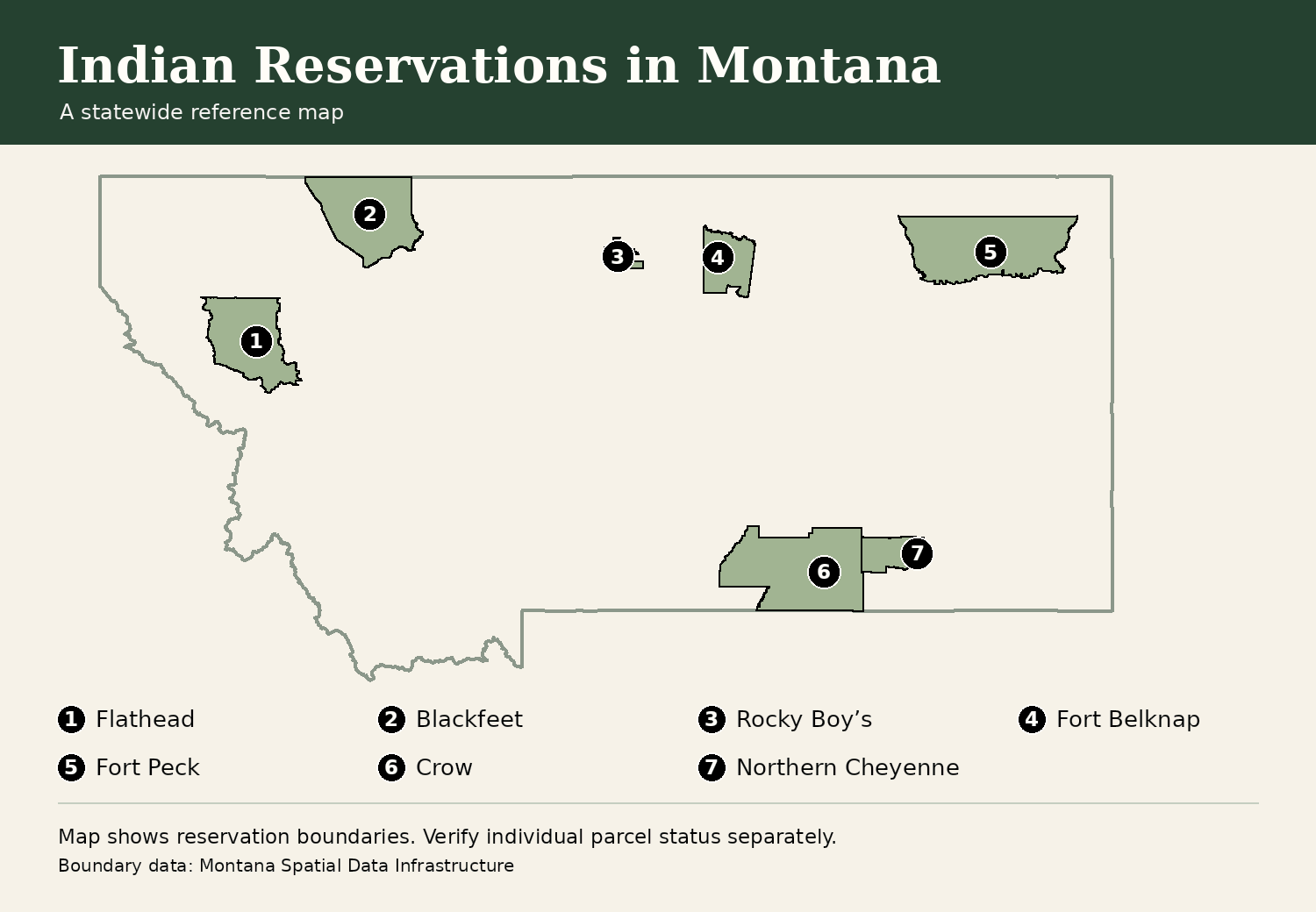
Use the map for general orientation and verify the legal description and land status for any parcel you’re considering. The Little Shell Tribe of Chippewa Indians of Montana is headquartered in Great Falls and does not have a reservation in Montana.
What are you actually buying?
Land within reservation boundaries can have different ownership and transfer rules. The title or lease records tell you what interest is available. For trust or restricted land, the Tribal realty office or Bureau of Indian Affairs (BIA) can help identify the records and approvals that apply.
| What the listing may involve | What to verify before committing |
|---|---|
| Fee-simple land | Ask a title company familiar with reservation transactions to verify ownership, the proposed deed, easements, and recorded restrictions. Confirm building and utility approvals separately. |
| Trust land | The United States holds title in trust for a Tribe or individual Indian landowner. Ask the Tribal realty office or BIA what interest can be transferred, who is eligible, and what approvals or consents apply. |
| Restricted fee land | A Tribe or individual Indian landowner holds title subject to federal restrictions on transfer or encumbrance. Ask which approvals apply to the proposed sale and financing. |
| Leasehold or improvements on leased land | Ask whether the transaction includes a building, an assignment of a lease, or both. Review the remaining term, renewal provisions, transfer requirements, and what happens to improvements when the lease ends. Confirm financing early. |
What to verify before your due diligence deadline
- Legal access and utility routes. Ask for the documents that establish road access and the right to run power, water, or other utilities across neighboring land. Confirm that the recorded or approved routes match the routes you’ll actually use. For trust or restricted land, ask which office maintains the records and whether a Title Status Report is available.
- Your building plans. Give the relevant offices the legal description and explain what you want to build, including any guest dwelling or future lot split. Ask which Tribal, county, or federal offices review your plans and what written approvals you’ll need.
- Drinking water and irrigation. If there’s a well, ask for the well log, records showing authorized use, and any shared-well documents. Check yield and water quality separately. If the listing mentions irrigation, ask who delivers it, what transfers, and what fees or restrictions apply.
- Septic and site conditions. Ask who handles septic review for the parcel. Request any existing permit and site evaluation records. For vacant land, ask about a suitable drainfield area, seasonal groundwater monitoring, and whether approval is available for the home you’re planning.
- Financing and closing. Give your lender and closing team the title or lease documents early. If a transfer requires consent or approval, ask who handles it and when it needs to be in place.
A local example from the Flathead Indian Reservation
On the Flathead Indian Reservation, the Flathead Reservation Water Management Board administers water rights. If you’re planning a qualifying individual or shared domestic well, its Office of the Engineer lists Form 60DF Part A before well construction and Part B after you put the well to use. Ask the office to confirm the route for your parcel before scheduling drilling.
If the parcel receives water through the Flathead Indian Irrigation Project, contact the project operator to confirm delivery details, assessments, and what account or ownership updates are needed. For questions involving Tribal land records or homesite leases, CSKT’s Tribal Lands Department provides a separate starting point.
The most productive first step
Take the legal description and a short description of what you want to do with the land to the appropriate offices. If a parcel looks promising, work those questions into your due diligence period so you have time to get answers before closing.
Helpful Resources
Official starting points for land status, title records, water, and septic questions.
BIA Land Title Services
Title and encumbrance records for trust and restricted land, including Title Status Reports.
Visit BIA →Trust & Restricted Land
BIA’s overview of how trust and restricted land is held.
Read the overview →Leasehold Mortgages
BIA guidance on financing improvements on leased land.
See the guidance →Flathead Water Management Board
Water rights forms for the Flathead Indian Reservation, including Form 60DF.
See the forms →CSKT Tribal Lands
A starting point for Tribal land records and homesite lease questions.
Visit CSKT →EPA Septic Permitting
Who permits septic systems and common questions to ask.
Learn more →Considering land on a Montana reservation?
I can help you gather the legal description, title or lease documents, and permit records early, and know which offices to ask before you commit.
Book Your ConsultationCourtney Ferguson · Real Broker, LLC · courtney-ferguson.com
This information is for general educational purposes and is not legal, title, or financial advice. For a specific parcel, contact the Tribal realty office, the Bureau of Indian Affairs, or a title company familiar with reservation transactions.

Courtney Ferguson is a Montana Real Estate Broker and REALTOR® with The Real Brokerage, based in Stevensville. She is a licensed broker and helps buyers and sellers across The Bitterroot Valley, including Lolo, Florence, Stevensville, Victor, Corvallis, Hamilton, Darby, Conner, and Sula. Same-day consultations are available, including weekends and holidays.