
Ravalli County Water Rights
Ravalli County water rights: what does a well, creek, or irrigation ditch mean for your property?
In the Bitterroot Valley, the water that comes with a property can matter as much as the land. Before you buy acreage, know where the water comes from, what it’s authorized for, and what actually transfers at closing.
Book a Free ConsultationWater Rights in Ravalli County: What a Well, Creek, or Irrigation Ditch Means for Your Property
Say you’re looking at a five-acre property near Hamilton, Corvallis, or Stevensville. There’s a well by the house, a ditch along the fence, and a field that looks like it’s been irrigated for years. The listing says “water rights.” What can you actually use the water for, and what comes with the property?
Start with two questions: Where does the water come from? And what is it authorized to be used for? Then check whose right it is and which land it serves.
Why do water rights matter so much in the Bitterroot Valley?
The Bitterroot River basin and its subbasins are closed to most new water permits under Montana law. That closure stays in place until the basin’s water rights are fully decreed and enforceable. There are exceptions, including some groundwater permits and the small-well exception covered below. But in most cases you can’t simply apply for a new right to irrigate from a creek. That makes the rights already attached to a property, and the ditch that delivers the water, an important part of what you’re buying.
What’s the difference between surface water, groundwater, domestic, and irrigation rights?
Montana water rights authorize a specific use of water. A right can specify where the water is taken, where it’s used, what it’s used for, how much can be diverted, and when it can be used. Priority also matters. Montana generally follows “first in time, first in right,” so when there isn’t enough water, a senior right (one with an older priority date) can take priority over a junior one. In a dry Bitterroot summer, that priority date can decide whether a field gets water in August.
| Term | What it tells you |
|---|---|
| Surface water | The source is above ground, such as a creek, river, lake, or reservoir. A ditch can carry surface water from a diversion upstream. |
| Groundwater | The source is below ground, commonly accessed through a well. |
| Domestic use | The water is authorized for household needs such as drinking, cooking, bathing, and laundry. Check the record for any lawn and garden use or other authorized purposes. |
| Irrigation | The water is authorized to irrigate land, such as a hayfield, pasture, or crop acreage. The right can be tied to specific acreage and a season of use. |
| Priority date | The date the right was established. Older (senior) rights are filled first when water runs short. |
Surface water describes the source. Domestic and irrigation describe the purpose. A well can supply household water and, if authorized, irrigation water. A creek can supply irrigation water under a surface-water right. On DNRC’s current groundwater form, domestic, lawn and garden, irrigation, and livestock are listed separately. If your plans include a garden, a second home on the parcel, or irrigating a pasture, check whether the record covers that specific use.
What should I check when a property has a well or irrigation?
For a private well, ask for both the well log and the water right record. The well log documents the well and its construction. The water right record shows what uses are covered. Search the DNRC Water Rights Query System by property location and place of use as well as owner name. The record may still list a prior owner. If the well is shared, ask for the shared-well agreement and check which homes are covered and how the parties handle access and maintenance.
For surface-water irrigation, ask who holds the right and how water reaches the property. The seller may hold an individual water right, or a ditch company, water users’ association, or irrigation district may hold the right and deliver the water. In the Bitterroot, that could be the Bitter Root Irrigation District (the “Big Ditch”), the Daly Ditches, or a smaller private ditch company. Ask for the water right number, the map of authorized acreage, and any share certificates, assessment statements, or delivery records. Where a provider delivers the water, confirm directly what transfers, what fees or assessments apply, and when the property typically receives water.
If a ditch crosses the property, it may serve land farther downstream. Under Montana law, you can’t encroach on or otherwise impair a ditch easement without the holder’s written consent. Whoever holds the easement also has the right to come onto the land to inspect, repair, and maintain the ditch, even where it has been piped. Before you plan a fence, driveway, outbuilding, or landscaping near a ditch, find out who uses it. If the ditch that serves your property crosses neighboring land, ask for documents showing delivery and maintenance access.
Buying a home with a private well? Here’s what to investigate
A working faucet tells you the pump is delivering water today. Before you buy, find out whether the water is safe to drink, whether the well can keep up with the household, and what it will take to maintain the system.
- Get a fresh drinking-water test. Work directly with a certified lab and follow its sampling instructions. Ask about total coliform, E. coli, and nitrate/nitrite, plus contaminants relevant to the location, such as arsenic or uranium. MSU Extension has testing guidance by county. If there’s a treatment system, ask the lab where to sample so you know what’s coming from the well and what’s reaching the drinking-water tap. MSU Extension testing guidance and certified labs · County-by-county guidance
- Check how much water the well can reliably supply. Ask for the well log and any recent pump or yield test. The log can show the depth and what the well produced when it was drilled. Ask the seller about low pressure, interruptions, or water shortages in late summer. Have a licensed well contractor assess current yield and recovery after pumping, especially if the well has a history of low production or will serve multiple households. Compare that supply with your expected demand. Water Systems Council guide to well flow and yield
- Inspect the equipment and the area around the well. Have the contractor check the well cap and casing, pump, pressure tank, controls, and any filters, treatment equipment, or storage tanks. Ask for installation dates, repair invoices, and treatment service records. Locate the septic tank and drain field, including nearby systems if relevant. Ask the county environmental health office about available permits and required separation distances. If the property has a septic system, arrange a separate septic inspection. Montana DEQ private well and septic resources
- Match the well to the paperwork. Compare the well log and the DNRC water right record with the well serving the home. Confirm the authorized uses and which property or homes it serves. If the well is shared or located off-site, ask for the recorded agreement and any easements. Check who can access the well and lines, who pays for power and repairs, and how the agreement handles shortages or pump replacement. DNRC’s guide to checking water rights
Schedule the inspection and sampling early enough to receive the results before your inspection deadline. If you’re financing the purchase, ask your lender what tests, sampling procedures, or reports it requires. If a result raises a concern, use the inspection period to find out what it would take to address it and whether follow-up testing is needed. MSU Extension guidance for real estate water testing
How do I test a private well for bacteria?
For a bacteria test, ask for total coliform and E. coli. Total coliform can signal that surface water or other contamination is getting into the system. E. coli points to possible fecal contamination and calls for prompt action. Test at least annually and after flooding or work on the well. If you’re buying a home, schedule the test early enough to receive a written report before your inspection deadline. MSU Extension bacteria guidance · EPA private-well testing guidance
- Get a sterile sample bottle and instructions. Ask the lab which tap to use, especially if the home has a softener, filter, or UV system. A sample at the drinking-water tap shows what reaches the household. The lab may suggest a second sample before treatment to help identify where a problem starts.
- Collect the sample as directed. The lab may ask you to remove the faucet aerator, clean the outlet, and run cold water before sampling. Avoid touching the inside of the bottle or cap. Leave any preservative in the bottle and fill to the marked line.
- Deliver it promptly. Label the bottle with the collection time and follow the lab’s instructions for cooling, drop-off, and timing. Arrange the drop-off before collecting. MSU Extension sampling and lab guidance
Where to test near Missoula. Culligan of Missoula offers well-water testing and lists bacteria testing as an additional lab option. Ask specifically for total coliform and E. coli, the cost, turnaround time, and a written lab report. Its free in-home screening is a separate service. Missoula Public Health also tests private wells for both bacteria at its state-accredited lab. For a purchase, confirm any sampling and lab requirements with your lender before ordering. Culligan of Missoula · Missoula Public Health lab · Certified Montana labs
What happens when you shock a well?
If E. coli is detected, stop using the water for drinking, cooking, making ice, brushing teeth, and preparing infant formula. Use bottled water or another verified safe supply and contact your county environmental health office. If only total coliform is detected, ask the lab or county whether to collect a confirmation sample and how to handle water use in the meantime. MSU Extension bacteria guidance
Shock chlorination is a one-time disinfection of the well and the connected plumbing. A licensed well contractor can check for entry points such as a damaged cap, leaks, or drainage toward the well, then determine whether disinfection is appropriate. If contamination keeps entering the system, it can return after treatment.
- Prepare the system. Set aside a safe supply for drinking and cooking. The contractor calculates the disinfectant dose from the well dimensions and bleach concentration, and checks whether treatment equipment needs to be bypassed or handled separately.
- Disinfect the well and plumbing. The chlorine solution is circulated through the well and drawn through the affected plumbing. MSU Extension’s private-well procedure calls for 12 to 24 hours of contact time. Follow the protocol for your system and use a safe alternative drinking-water supply during treatment.
- Flush and retest. Follow the contractor’s directions for flushing and keep heavily chlorinated water out of the septic system, streams, and ponds. Once the chlorine has cleared, coordinate follow-up testing for total coliform and E. coli with the lab or county. MSU Extension calls for waiting at least 72 hours after chlorine has cleared before retesting under its procedure. Keep using a verified safe water supply until follow-up results confirm the bacteria are absent. If bacteria return, have the system investigated for an ongoing source. MSU Extension’s shock chlorination procedure
Is the water right “decreed,” or still a claim?
Montana is still working through a statewide adjudication. The Montana Water Court is confirming water rights that were established before July 1, 1973, basin by basin, and Bitterroot claims are at different stages of that process. When you pull a water right abstract, look at its status and any “issue remarks.” A remark can flag a question about the right’s flow, acreage, or priority date that hasn’t been resolved yet.
How have Montana’s exempt-well rules changed?
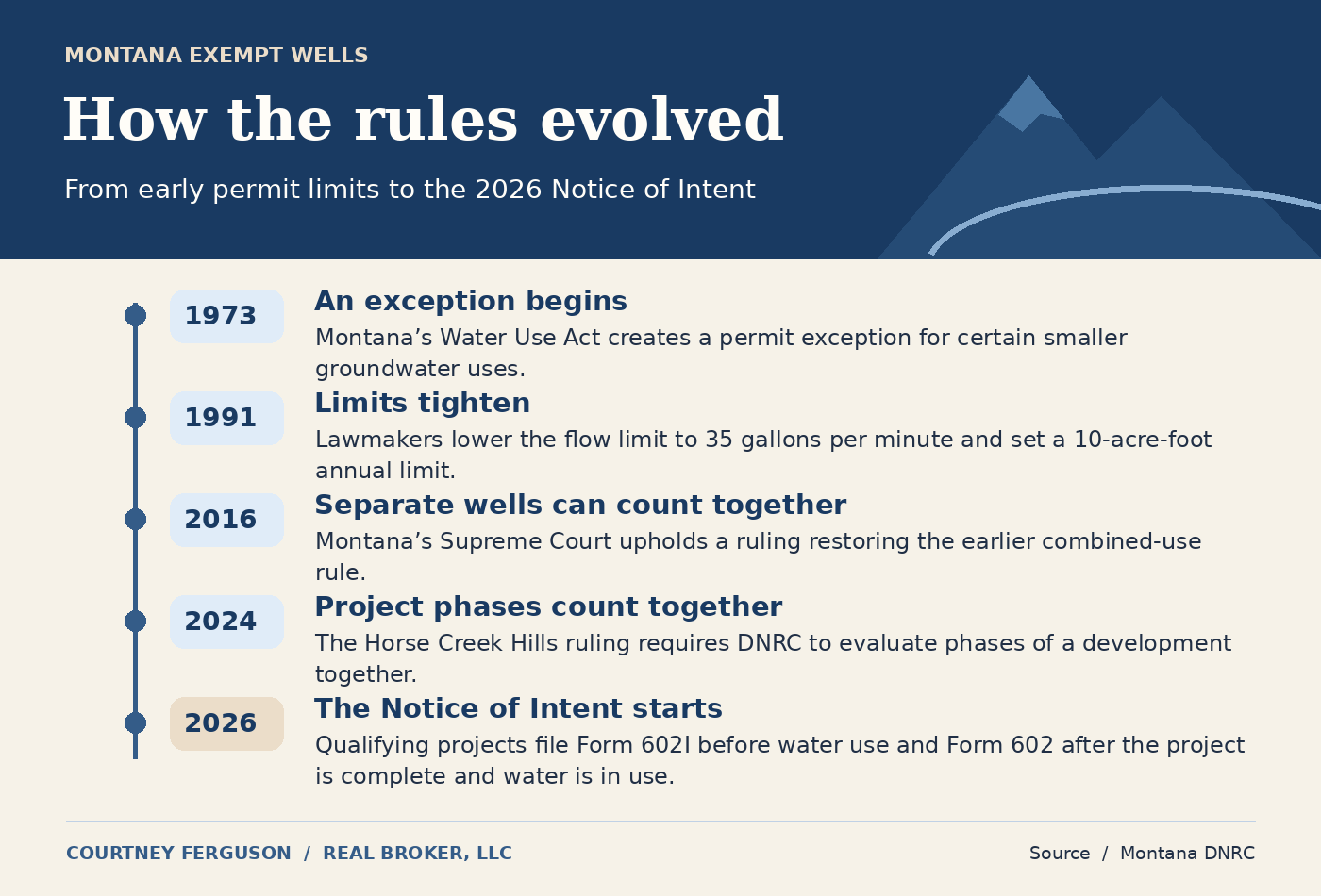
Montana’s groundwater permit exception has changed as lawmakers and courts have addressed when multiple wells should count as one project. DNRC can evaluate wells in phases together even when the wells have separate plumbing.
How do I get a new groundwater right in 2026?
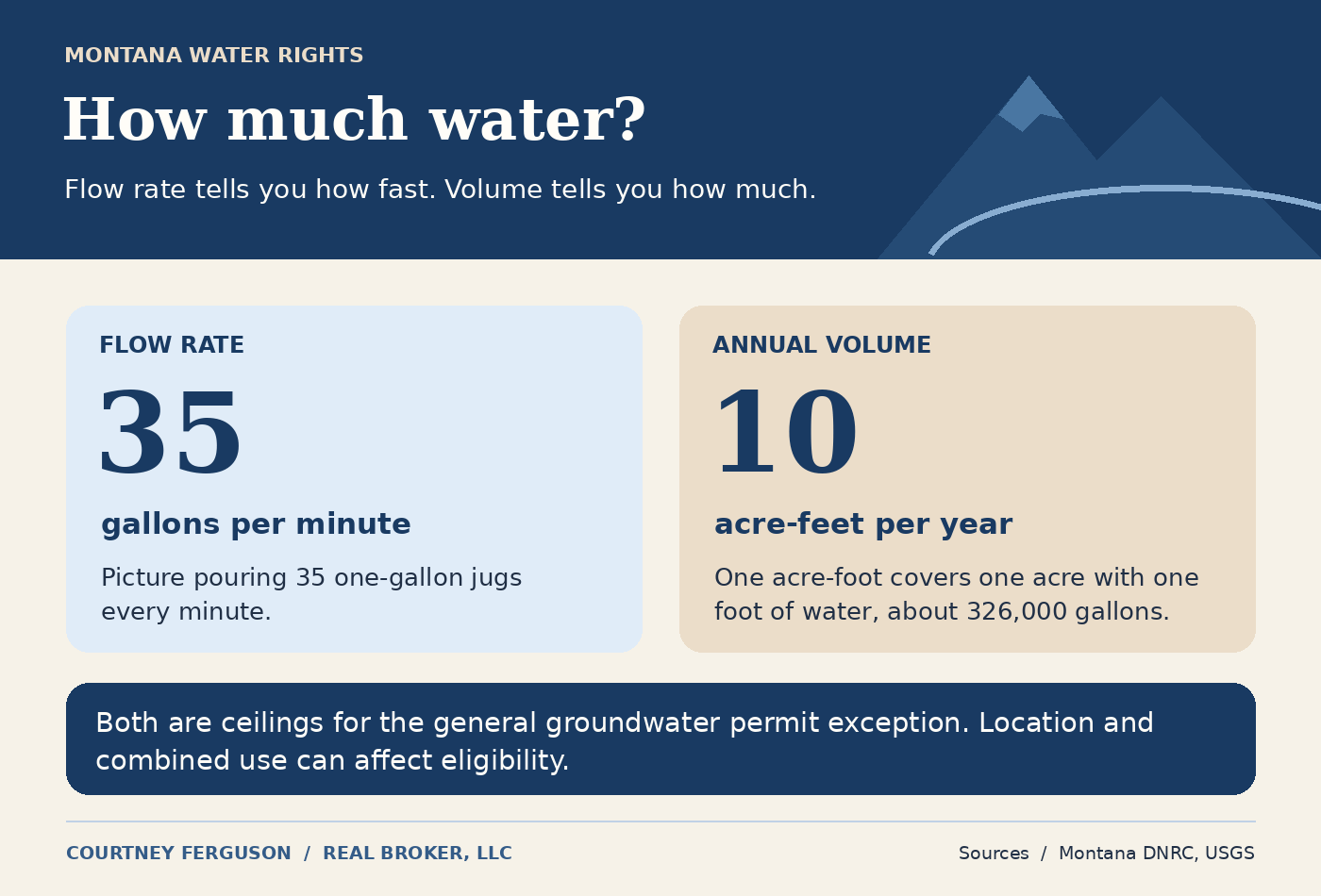
Since January 1, 2026, Montana has required a Notice of Intent to Appropriate Groundwater (Form 602I) for projects using the small-groundwater permit exception covered by House Bill 681. Where the general exception applies, the proposed use must be 35 gallons per minute or less and no more than 10 acre-feet per year. DNRC can count related wells drawing from the same source together when evaluating a project. Controlled groundwater areas, basin closures, and compact areas can affect what’s available and which rules apply. In designated stream depletion zones, the statutory limits are 20 gallons per minute and 2 acre-feet per year. Ravalli County has one: the Rye Creek Stream Depletion Zone.
- Check the parcel and describe the full project. Contact the DNRC Water Resources Regional Office serving the property. For Ravalli County, that’s the Missoula Regional Office. Have the parcel geocode or legal description, proposed well location, and a list of planned uses handy. For irrigation, be ready to describe the crop and acreage. For an existing well, include the well log if available.
- File Form 602I with the regional office and pay the $400 filing fee. You can file before or after drilling. For a new use, get DNRC authorization before putting the water to use. Filing before drilling gives you an eligibility decision before you invest in a well.
- Wait for DNRC’s decision. DNRC has 10 business days to authorize or deny the notice once it determines the filing is correct and complete. An authorized notice establishes that the proposed use qualifies for the exception. The groundwater certificate comes after the completion filing.
- Complete the project, put the water to use, and file Form 602. Follow the authorized plan and file the Notice of Completion of Groundwater Development within 60 days after the development is complete and the water is put to beneficial use. DNRC instructs applicants to complete the project and submit Form 602 within five years of authorization, unless DNRC grants an extension. Form 602 has a $250 filing fee. DNRC then processes the filing for a groundwater certificate.
Download the well forms
These are the two DNRC forms for a new well under the small-groundwater exception. Each form lists the current filing fee and instructions on the first page.
Form 602I: Notice of Intent ($400)
Form 602: Notice of Completion ($250)
File with the DNRC Missoula Regional Office (serves Ravalli County): 2705 Spurgin Road, Building C, Missoula · 406-721-4284 · DNRCMissoulaWater@mt.gov
If the well is already in use and you can’t find a water right, start by asking DNRC to check the property’s records. DNRC says the new notice is generally required before it can process a completion filing, even for an already-drilled or operating well, unless Form 602 was pending before January 1, 2026. An existing water right or an older use can change which steps apply, so bring the well log and any prior paperwork.
When do I need a permit or a change to an existing right?
If you want to start a new diversion from a creek for irrigation, or your groundwater project falls outside the permit exception, ask DNRC about Form 600, Application for Beneficial Water Use Permit, before developing the new use. Because of the Bitterroot basin closure, new surface-water permits are generally not available here, so ask DNRC early whether any exception applies. Where a permit is possible, the process generally involves a more extensive review, including water availability, potential effects on existing rights, and public notice. If you already have a right and want to change the purpose, diversion point, place of use, or place of storage, ask whether DNRC approval through Form 606 is required.
Do water rights transfer when I buy the property?
Usually, yes. Under Montana law, a water right passes with the land when it’s sold, unless the deed specifically excludes it, and it keeps its original priority date. But don’t assume. A seller can reserve or sever a right, and a right can be split when land is divided.
What happens at closing
The purchase agreement for land with water rights on record must include a water right ownership update disclosure.
The Realty Transfer Certificate filed at closing includes a water rights disclosure. The seller states whether any water rights will transfer with the property.
DNRC updates its ownership records after closing, and a fee is due at closing. If the seller wasn’t the owner of record, or the land is being split, the buyer may need to file a Water Right Ownership Update (Form 608, or a split or severance form) within 60 days. If the land is divided, each new owner files a form, a map, and the fee. Otherwise DNRC records the parties as co-owners of the right.
If an irrigation district or ditch company delivers the water, the district’s own records and assessments transfer separately, so contact the district too.
If you’re buying acreage, pull the records early enough to check them against your actual plans. A property that works for a home and a small garden may need different water arrangements to irrigate a hayfield. Before closing, confirm which rights or delivery arrangements will transfer and whether the deed, closing documents, and provider records reflect that agreement.
Montana water rights glossary
| Term | What it means |
|---|---|
| Water right | A legal right to use water from a specific source, subject to the terms of the right. |
| Surface water | Water from a source above ground, such as a river, creek, or lake. |
| Groundwater | Water below ground, commonly accessed through a well. |
| Beneficial use | A recognized purpose for using water, such as household use, irrigation, or watering livestock. |
| Domestic use | Household water use, such as drinking, cooking, and bathing. Check the record for any lawn and garden use. |
| Irrigation | Water applied to land to grow crops, hay, or pasture. Check which acres and season the right covers. |
| Point of diversion | Where water is taken from its source, such as at a well or a creek headgate. |
| Place of use | The land or location where the water is authorized to be used. |
| Priority date | The date used to rank a water right. Older rights generally have priority when water is scarce. |
| Flow rate (GPM) | How fast water is diverted, often measured in gallons per minute for wells. |
| Acre-foot (AF) | A measure of volume. One acre-foot covers one acre one foot deep and equals about 326,000 gallons. |
| Exempt well | A well whose proposed use qualifies for an exception to the standard water-use permit process. |
| Combined appropriation | When DNRC evaluates water use from two or more wells or developed springs drawing from the same aquifer together. Separate plumbing can still count as one use. |
| Notice of Intent (Form 602I) | The form used to seek DNRC authorization for qualifying groundwater use before putting the water to use. |
| Groundwater certificate | The water right DNRC issues for qualifying groundwater use after it accepts the completion filing (Form 602). |
| Well log | A record of how the well was drilled and constructed. It is separate from the water right record. |
| Ditch share | A share in a ditch company or water users’ association that can provide access to water deliveries under the organization’s rules. |
Buyer’s water rights checklist for Ravalli County
- Water right numbers and abstracts from the DNRC Water Rights Query System, searched by location, not just owner name
- Priority date, flow rate, volume, season of use, and authorized acreage for each right
- Adjudication status and any issue remarks on the abstract
- Well log, plus the groundwater certificate or filing for each well
- Shared-well agreement, if the well serves more than one home
- Ditch company or irrigation district contact, shares, assessment history, and delivery schedule
- Ditch easements and access across neighboring land, plus any ditches crossing the property that serve others
- Whether the deed and Realty Transfer Certificate show the water rights transferring
- Whether your plans (garden, pasture, second home, livestock) fit what the rights actually allow
Helpful Resources
Official Montana tools for looking up water rights, area restrictions, and forms.
Water Rights Query System
Search DNRC’s records by location or owner to find the water rights tied to a property.
Search water rights →Basin Closures & Restricted Areas
See basin closures, stream depletion zones, and controlled groundwater areas.
View restrictions →2026 Well Rules
DNRC’s guidance on the new Notice of Intent (Form 602I) for small groundwater wells.
Read the guidance →Update Water Right Ownership
Forms for transferring, splitting, or severing a water right after a sale.
See ownership forms →Adjudication Basin Status
Check where Bitterroot basins stand in the Montana Water Court’s statewide adjudication.
Check basin status →Questions about water on a Bitterroot property?
Whether you’re looking in Florence, Victor, Darby, or anywhere in between, I can help you gather the records early and know which questions to ask before you commit.
Book Your ConsultationCourtney Ferguson · courtney-ferguson.com
This information is for general educational purposes and is not legal advice. Water rights can be complex. For a specific property, contact the Montana DNRC Missoula Regional Office or a Montana water rights attorney.

Courtney Ferguson is a Montana Real Estate Broker and REALTOR® with The Real Brokerage, based in Stevensville. She is a licensed broker and helps buyers and sellers across The Bitterroot Valley, including Lolo, Florence, Stevensville, Victor, Corvallis, Hamilton, Darby, Conner, and Sula. Same-day consultations are available, including weekends and holidays.